
Menu
The First to the Front
Модел 1899
When the Great War descended upon the old continent in 1914, the Serbian Royal Army was the first to be forced to take up arms. Short on uniforms, ammunition and other equipment, their soldiers and excellent rifles would help them fend off the Austro-Hungarian forces against the odds.

History
Serbia emerged as an independent state in the aftermath of the Russo-Ottoman War of 1878.
The new kingdom, like its neighbours wanted to standardise on a modern rifle and chose an improved Mauser 1871 single-shot in 1880 – a black-powder arm that was sensible at the time but obviously dated by the 1890s.
During this early Mauser period Major Ivanović worked closely with Peter and Wilhelm Mauser, chiefly on ammunition. He later married into the Mauser family, which helped anchor a long-term connection between Serbian ordnance and German arms makers. At the same time Georg Luger promoted German interests in Serbia, including securing adoption of Maxim machine guns made by DWM and acting as an information conduit on regional armament.
Politically, Serbia sat between Austro-Hungarian and Russian influence. King Milan I (1882-1889) leaned towards Vienna, while much of the population favoured Russian-backed pan-Slavism. The result was a persistent tug-of-war over Serbia’s orientation, with Austria-Hungary trying to make Serbia a satellite and using economic and financial pressure to restrict Serbian access to foreign credit and arms.
To support modernisation and deter an Austro-Hungarian incursion, Serbia built a broad conscription system on the Montenegrin model, but more structured:
First ban: from about age 21, with the small peacetime regular army and reserves – the front-line wartime force.
Second ban: up to about age 38 – replacement drafts and a militia-like element for reinforcing the front.
Third ban: roughly 38–45 – rear-area duties, lines of communication, home defence.
A final reserve class covered 18–20 and 45–50, for emergency training and non-combat roles.
Feeding this system demanded a large pool of rifles. By the early 1890s, new developments in small arms technology made the 1880 black-powder Mausers obsolete for front-line use.

Костантин Миловановић (Konstantin Milovanovic) (1847-1905)
In 1891 the War Ministry formed a commission to select a new smokeless rifle. After about two years of trials they chose the very new Mauser Model 1893, specifically in the Spanish 7×57 mm configuration – a flat-shooting, efficient cartridge with an excellent balance of power, trajectory and recoil.
Serbia hoped to buy around 100,000 rifles, but the financing failed. A follow-up attempt was made with Russia, seeking to adopt the Mosin–Nagant 1891 with Russian financial support, but Russian production priority and lack of credit meant this also fell through.
Behind much of this difficulty was Austro-Hungarian interference. Vienna used its influence with banks and trading houses to block or delay Serbian loans and arms orders, aiming to keep Serbia dependent and within its own sphere of influence.
While Serbia struggled with financing its arms procurement, Mauser continued to refine the 1893 family, leading to what is broadly recognised as the Model 1895 pattern. Externally it remained very close to the 1893, but incorporated small improvements such as:
A round bolt face again, as well as the root of the bolt handle acting as a third locking abutment against a small shoulder on the receiver wall – an emergency locking surface behind the main front lugs.
This is the pattern Serbia would eventually adopt, adapted to its own requirements and marked as the Model 1899.
Meanwhile, Serbian reorganisation and population growth pushed the requirement up from 100,000 to about 130,000 front-line rifles, plus substantial ammunition stocks.
Financing and the DWM contract
Serbia eventually secured a loan from the Union Bank of Vienna of 30 million gold dinars, with the bulk intended for Mauser purchases. By the time the rifle order was placed in 1899, the bank only released a little over a third immediately and promised the rest later – a further example of Austro-Hungarian leverage.
As a result Serbia could only order:
90,000 rifles instead of 130,000, and
Ammunition reduced from the intended 1,000 rounds per rifle to about half that.
Because Mauser Oberndorf was heavily engaged in other contracts, the manufacturing work went to Deutsche Waffen- und Munitionsfabriken (DWM) in Berlin. The first batch rifles and cartridges was ready by June 1899. These were inspected in Germany and then sent by rail to Serbia, but were held up for two months by Austro-Hungarian customs and permitting, delaying final approval.
Early in service, Serbia discovered a serious issue shared with the original 1893 pattern: the rear of the barrel was flush, leaving a short length of the cartridge case unsupported between chamber and bolt face. Because the 7×57 mm is a rimless, shoulder-headspacing round, any error in chamber depth plus that unsupported section encouraged case bulges and separations. Within months, Serbian rifles were seeing case failures and extractor damage, especially where DWM’s chamber reaming had been slightly off.
Rather than simply send rifles back, engineers at the Military Technical Institute in Kragujevac re-worked the design:
Barrels were set back slightly and the chamber rear was reshaped,
A circular recess and rectangular extractor cut were machined so that the case head was fully enclosed and supported, correcting headspace as they went.
At around the same time, the rifles also received updated rear sights, moving away from the tilting button in favour of a stronger design proposed at Kragujevac.
Although the initial order from Germany had been fullfilled by the mid-1900s, the Serbian mobilisation plan required more than the 80,000-90,000 M1899s in inventory.
Thus in 1906, courtesy of a French loan, Serbia ordered another 30,000 examples.
Ironically these would come from the biggest opponent of Serbian armament - Austria-Hungary.
These Steyr-made examples, known as M1899/07 would incorporate the aforementioned changes from the get-go, as well as further minor changes like improved gas-venting.
The markings were changed accordingly denoting the updated pattern.

Though plenty modern when introduced, the Berdan II was woefully outdated by 1914. The precarious supply and armament situation in Serbia however meant that it still saw use during the Great War

Despite having doubled its territory after the two Balkan Wars, Serbia set further ambitions northwards, where it sought to acquire Bosnia-Herzegovina from Austria-Hungary and to annex the provinces of Vojvodina, Banat, the Kingdoms of Croatia-Slavonia and Dalmatia, and the Duchy of Carniola with the aim of uniting them into a South Slavic state
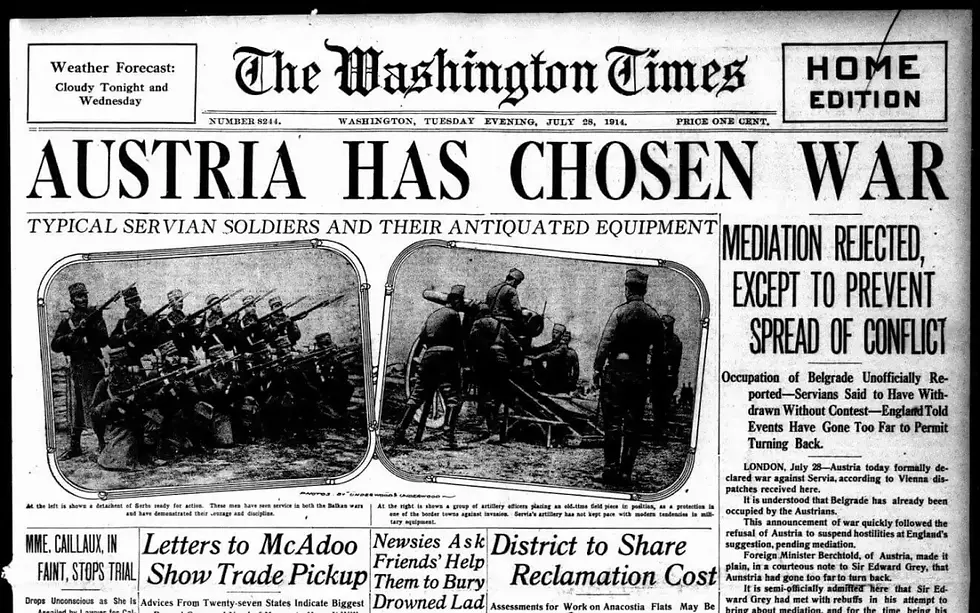
The Washington Times commenting on Serbia's rag-tag armament at the outbreak of the war
The M1899s trial by fire came just a few years after the two orders were fulfilled.
In October 1912 the Balkan League declared war on the then-hegemon in the Balkans, the Ottoman Empire.
The already proven Mauser design faired as well as expected in comparison with both its allies' weaponry, being mostly designs from Steyr, as well as against its cousins carried by Ottoman soldiers.
It would serve the Kingdom well yet again a few months later, when Bulgaria, having felt that they were dealt only an unfair share of the spoils, attacked Serbia and Greece.
The two Balkan Wars, though decisively won, left Serbia with a lack of basic equipment and armaments.
Though the M1899 pattern remained standard, by 1914 it was clear the remaining rifles would not be able to equip the army in full, which is why both outdated and captured equipment was incorporated into the logistics system, complicating it.
When the fateful shots of Sarajevo on the 28th of June 1914 killed Franz Ferdinand, heir presumptive to the Austro-Hungarian throne, and his wife, it quickly became clear that yet another war was on the horizon, approaching quickly.
On the 25th of July Serbia declared general mobilisation, despite accepting all but the most egregious demands of the July 23rd ultimatum by the Austro-Hungarian Empire.
Three days later Austria-Hungary declared war and artillery opened fire on Belgrade, the opening stroke of the Great War.
Only around a third of the Serbian Army were equipped with M1899s early in the war. The rest of the small arms were made up of a consortium of outdated rifles like the Mauser M1880 and Berdan II, or captured Ottoman and Bulgarian rifles.
Additionally, Hundreds of thousands of Russian Mosin rifles were delivered to keep Serbia afloat, as well as a mix of other arms from the Entente.
Though ill-equipped, the Serbians in conjunction with their excellent rifles, battle experience, an early Russian offensive and Austro-Hungarian strategic blunders managed to hold the line far longer than could have been expected against its northern neighbour.
This initial success was paid for in horrendous loss of life and material, and the M1899 started to disappear by sheer volume of attritional losses.
Although Serbia was ultimately overrun in 1915, the M1899 continued serving both with the remains of the Serbian Army, as well as the Austro-Hungarians, who took captured examples into their own varied roster of small arms.
After the war, when Serbia "disappeared" in the newly formed Kingdom of Serbs, Croats and Slovenes, the M1899 would see a modification process in the form of a shortening to the new M1924 pattern length, as well as being rechambered to 8x57mm, known as the M1899C.
This program and the incredible loss of material in the three wars it partook in makes original Serbian rifles one of the rarest to encounter today.

Serbian soldiers with shouldered M1899 rifles
Mechanism
Bolt
The Serbian Mauser Model 1899 uses the Mauser 1893/95 pattern turn-bolt.
The bolt is a one-piece body with two opposed locking lugs at the front. When the bolt handle is turned down, these lugs seat into corresponding recesses in the receiver ring and take the main firing load.
A small but important change over early 1893s is the use of the bolt-handle root as an emergency locking lug. The rear bridge has a shaped shoulder so that, with the bolt closed, the flat base of the bolt handle bears against the receiver. In normal use the front lugs carry the load; the handle base is there as an additional abutment if a lug or its seat should fail.
The extractor is the same Mauser long, non-rotating claw mounted along the right side of the bolt as seen on all Mauser rifles M1893 onwards.
As a cartridge rises from the magazine, the rim is taken up under the claw and kept under control throughout feeding, firing, and initial withdrawal. This gives controlled feed.
Ejection is by a fixed blade ejector housed in the bolt stop on the left side of the receiver. As the bolt is drawn to the rear, the extracted case rides back until the rim strikes the ejector, which flicks it out to the right.
The safety is the typical Mauser flag safety mounted on the rear of the bolt. Rotated to the “safe” position it cams the cocking piece slightly back and blocks its movement, and also locks the bolt from turning; rotated over to the “fire” position it frees both firing pin and bolt.


Magazine
The Model 1899 has an integral, internal box magazine holding five rounds in a staggered column.
Unlike its cousin from the Ottoman Empire, the M1893, it lacks both the magazine cutoff, and a bolt hold-open on empty, meaning the bolt can be operated as normal even with an empty magazine without the follower blocking it.
Loading is from the top with a five-round stripper clip. The clip is set into the charger guides on the rear bridge and the cartridges are pressed straight down into the magazine. Closing the bolt clears the empty clip, which is lifted out as the lugs pass under it.
Unloading happens either by cycling the bolt to throw the rounds out, or by opening the hinged floorplate: the floorplate catch is depressed, the plate is swung down, and the spring and follower are allowed to relax, letting the cartridges fall clear. The floorplate is then closed and latched, giving access for cleaning of the magazine well when required.
Markings
Crest & Model Designation
Atop the receiver ring the the Serbian coat of arms can be found, underneath which the model designation in Cyrillic script can be seen. This varies between Model 1899 and Model 1899/07, for the Steyr contract.

Manufacturer & Acceptance Marks
The left side receiver wall will bear the manufacturer, again in cyrillic script for either DWM, or Steyr, both in their Serbian transliterations.
Acceptance marks show in the form of crowned letters and can be found on various parts like the receiver and bolt stop/release.

Serial Number & Proof Mark
The serial number is a simple numerical code found on parts like the receiver and bolt.
The proof mark takes the shape of a crowned T and can be found on the receiver and bolt.
